Introduction
If you’ve spent any time around AI in the past year, you may have come across a term that’s quietly become one of the most important in the industry: MCP, or the Model Context Protocol. It rarely makes consumer headlines, but behind the scenes it’s reshaping how AI connects to the tools and data businesses already use; and it’s worth understanding why.
The Problem MCP Solves
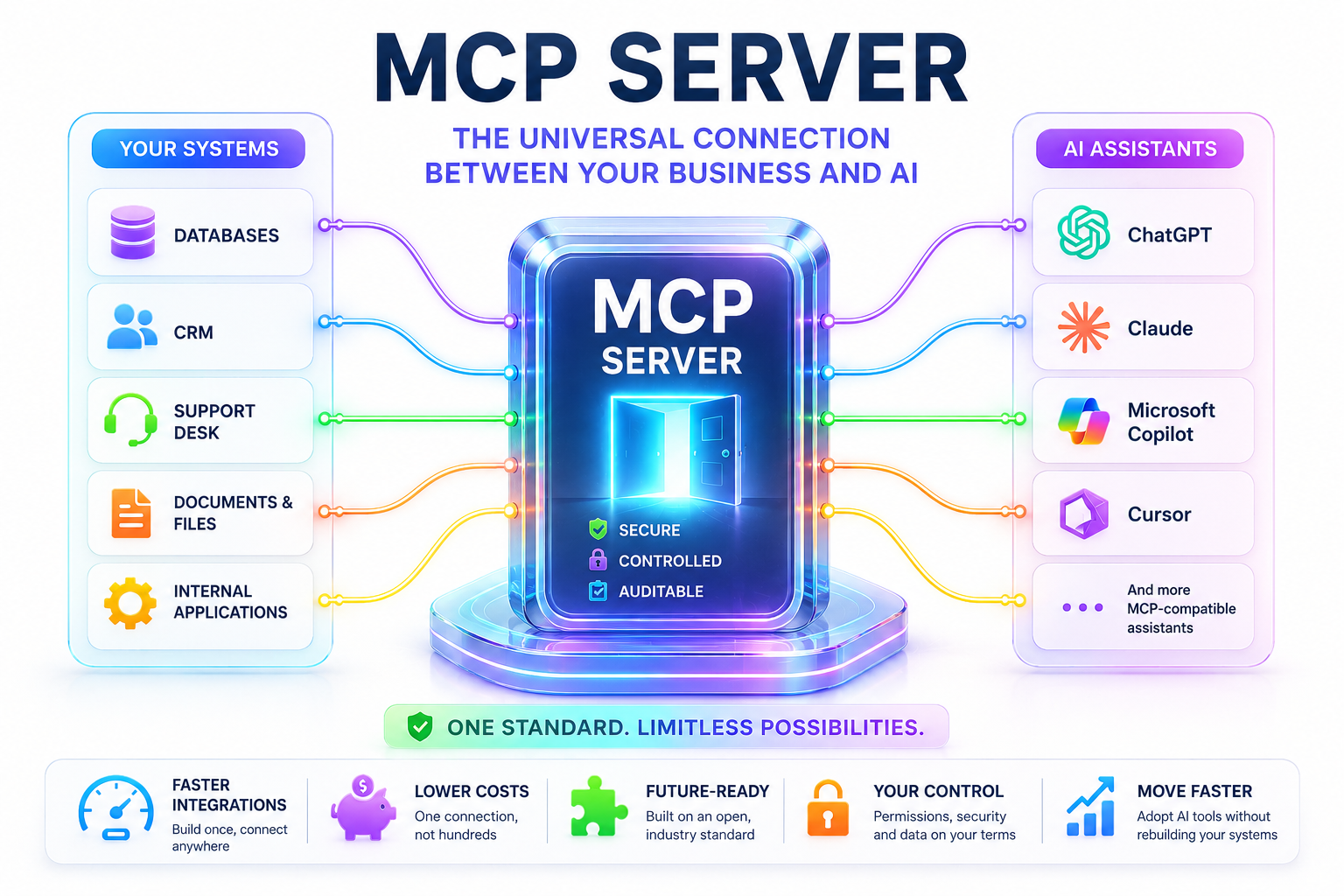
To appreciate MCP, it helps to picture the situation before it existed. Whenever a business wanted an AI assistant to work with one of its systems — a database, a CRM, a support desk, an internal application — someone had to build a custom, one-off integration. Connect it to a second system, and that meant building another. Every AI tool spoke its own language, and every connection had to be hand-crafted and maintained separately. It was slow, expensive, and fragile.
MCP changes that by acting as a universal standard — often described as “USB-C for AI.” Instead of building a bespoke connection for every combination of AI tool and business system, you build one MCP server for your system, and it works with any MCP-compatible AI assistant. The protocol turns a tangle of custom integrations into a clean, reusable connection.
From Niche Idea to Industry Standard
What makes this more than a passing trend is how decisively the industry has adopted it. Introduced as an open standard in late 2024, MCP has since been embraced by every major AI platform — the assistants, development tools, and enterprise platforms businesses actually use now speak the same protocol. It has been placed under independent, neutral governance, signalling that it’s here to stay rather than tied to any single vendor. In short, MCP has moved from an interesting experiment to foundational infrastructure in a remarkably short time.
For businesses, that matters. Industry analysts expect a large share of enterprise applications to include AI agents in the near future — and those agents need a standard way to interact with the software and data your organisation relies on. Increasingly, if your systems can’t be reached through this kind of standard connection, AI tools simply won’t be able to work with them.
What an MCP Server Actually Does for You
An MCP server is essentially a secure, standardised doorway between AI assistants and one of your systems or datasets. With one in place, an AI assistant can do things like look up information from your database, take actions in your internal tools, retrieve documents, or pull together data from across your business; all through a controlled, well-defined interface that you govern.
Crucially, this happens on your terms. A well-built MCP server defines exactly what the AI can and cannot access, enforces permissions, and can be deployed entirely within your own infrastructure so that sensitive data never leaves your control. It’s not about handing AI the keys to everything; it’s about giving it a precise, safe, and auditable way to be useful.
What We Can Build for You
This is an area we’re particularly excited about. We design and build custom MCP servers that connect your specific systems- databases, internal platforms, third-party services, or proprietary tools- to the growing ecosystem of AI assistants. That includes mapping your data and capabilities into a clean interface, building in the access controls and security your business requires, and deploying it wherever you need, including fully self-hosted setups for sensitive environments.
The result is a future-ready bridge between your business and AI: one that lets you adopt powerful AI tools without rebuilding your systems, and without surrendering control of your data. As AI agents become a standard part of how work gets done, the businesses with their systems already connected will be the ones able to move fastest.
If you’re wondering how your existing systems could plug into the AI tools your team is starting to use, an MCP server is very likely the answer; and we’d be glad to help you build one.
Ready to connect your systems to AI?
We design and build custom MCP servers that bridge your business and the AI tools your team is starting to rely on — securely, and on your terms.